Stainless steel is an alloy of Iron with a minimum of 10.5% Chromium.
 This prevents any further corrosion of the surface. Increasing the amount of Chromium gives a remarkable resistance to corrosion.
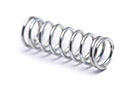
It is less expensive and reliable. It is most widely used in spring manufacturing because of its high corrosion resistance properties and good tensile strength. For spring applications, it is generally furnished in the cold drawn condition.
17-4
Learn More
17-7
Learn More
302 Stainless
Learn More
316 Stainless
Learn More
Alloy 20
Learn More
A286 Alloy
Learn More
Stainless Steel Springs FAQs
What makes a spring steel stainless, and when should you specify it?
Stainless steel is an alloy of iron with a minimum of 10.5 percent chromium. That chromium reacts with oxygen to form a thin passive film across the surface, and the film reforms if it is scratched, which is what stops corrosion from progressing into the base metal. Raising the chromium content raises corrosion resistance further. For spring work the material is generally furnished in the cold drawn condition, where tensile strength comes from the drawing operation rather than from a hardening heat treatment. Specify stainless when the spring sees moisture, washdown, process chemicals, or salt air and a coated carbon steel spring would eventually rust through.
Which stainless grades does Coiling Technologies coil?
Six grades are offered: 302, 316, 17-4 PH, 17-7 PH, Alloy 20, and A286. They fall into three groups. The austenitic grades, 302 and 316, take their strength from cold drawing and cover most general corrosion service. The precipitation hardening grades, 17-4 PH and 17-7 PH, are aged after forming to reach higher strength and higher allowable stress. Alloy 20 and A286 are the specialty picks, Alloy 20 for hot acid service and A286 for high temperature strength, since A286 is an iron nickel chromium alloy rather than a conventional stainless. Each grade has its own page carrying design values.
How do you choose between 302 and 316 stainless for a spring?
Both are austenitic and both coil well, so the decision comes down to chloride exposure against load capacity. 316 carries a molybdenum addition that 302 does not, and molybdenum is what resists pitting and crevice attack in salt water, road salt, and chlorinated process fluids. The tradeoff is strength. 302 spring wire reaches higher tensile strength in the cold drawn condition, so a 316 spring in the same envelope needs heavier wire, more coils, or a lower design stress to survive the same duty. For dry indoor service, 302 is usually the cheaper correct answer.
When does a precipitation hardening grade make more sense than an austenitic one?
Austenitic stainless can only be strengthened by cold work, which caps how much stress a 302 or 316 spring carries before it takes a set. 17-4 PH and 17-7 PH are formed in a softer condition and then aged, and the aging step raises yield strength well beyond what cold drawing alone delivers. Engineers reach for them when the load is high, the envelope is small, or the spring has to hold its free length under sustained stress. The cost is process complexity, since the aging cycle shifts dimensions slightly and free length and rate have to be verified after heat treatment.
Are stainless steel springs magnetic?
In the annealed condition 302 and 316 are essentially non-magnetic, but spring wire is not annealed. Cold drawing and coiling transform part of the austenite to martensite, so a finished 302 or 316 spring is weakly magnetic, and how magnetic depends on how heavily the wire was worked. 17-4 PH and 17-7 PH are martensitic after aging and are clearly magnetic. If the application genuinely requires low magnetic permeability, for example sensor assemblies or downhole measurement tools, a nitrogen strengthened austenitic grade such as Nitronic holds austenite far better through forming, and titanium is not ferromagnetic at all.
What does single facility processing change for a stainless spring order?
Design, prototyping, coiling, heat treating, shot peening, non-destructive testing, powder coating, and inspection all happen in one Houston facility under a single ISO 9001:2015 quality management system, with no outsourcing to outside vendors. For stainless that matters most at the heat treatment and finishing steps, where an outside vendor introduces a second quality system, added transit, and a handoff where traceability can break. Keeping the work in one plant also shortens the loop when a prototype comes off the test bench and the design needs a change, which is a large part of how Coiling Technologies holds lead times better than its industry counterparts.