Titanium (AMS 4957) has a high strength-to-weight ratio and a high resistance to corrosion.
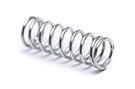
The special properties in titanium make titanium springs a strong, lightweight and durable option good for many applications. It has excellent corrosion properties and can withstand moderately high temperatures. Titanium springs are readily used in more demanding industries such as Aerospace, Aircraft, Military, and Motorsports which makes it the material of choice when you require low mass and high strength. The manufacturing of titanium springs requires great skill and experience. Our engineers have hands-on experience in designing, manufacturing, and heat-treating the various Titanium alloys. Although there are about 50 different alloys of Titanium, we can steer you toward the right Titanium alloy for your specific application.
During our manufacturing process, we do not contaminate raw titanium material while cold working or heat treating; this is achieved by vigorous cleaning of the material with chemicals prior to and after the heat-treatment process.
Titanium Springs FAQs
What are the primary advantages of titanium springs compared to steel springs?
The most significant advantage of titanium springs is their exceptional strength-to-weight ratio. Titanium alloys have approximately 55–60% the density of steel while achieving comparable or higher tensile strength, resulting in springs that are approximately 40–45% lighter than equivalent steel springs carrying the same load. Additionally, titanium offers excellent corrosion resistance in seawater, chloride environments, and many chemical media; good fatigue resistance; and biocompatibility—properties that make it uniquely qualified for aerospace, medical, and marine applications where weight and corrosion resistance are primary design drivers.
What titanium alloys are most commonly used for spring manufacturing?
The most common is Ti-6Al-4V (Grade 5, UNS R56400), a titanium-aluminum-vanadium alloy offering an excellent combination of high strength, good formability relative to other titanium alloys, and broad aerospace qualification history. Beta titanium alloys such as Ti-Beta-C (Ti-3Al-8V-6Cr-4Mo-4Zr) are used where very high fatigue strength and superior cold-forming characteristics are required, and are common in aerospace spring programs specifically for their ability to be cold wound more readily than Ti-6Al-4V. Commercially pure (CP) titanium grades (ASTM Grade 1 or Grade 2) are used where maximum corrosion resistance with lower strength requirements applies.
How much weight can a titanium spring save compared to an equivalent steel spring?
Titanium's density is approximately 0.160 lb/in³ compared to steel's approximately 0.284 lb/in³—making titanium approximately 44% lighter than steel by volume. In a direct comparison at the same dimensions, a titanium spring weighs approximately 44% less than an equivalent steel spring. In practice, the weight savings can be even greater when the spring geometry is specifically optimized for titanium's properties, since titanium's strength allows a reduced wire diameter for equivalent load requirements, further reducing mass. This weight advantage directly translates to improved performance in aerospace, motorsport, and high-performance applications.
How does Coiling Technologies prevent contamination during titanium spring manufacturing?
Titanium is sensitive to surface contamination during cold working and heat treatment. Coiling Technologies performs rigorous chemical cleaning of titanium material both before and after heat treatment to prevent surface contamination that could otherwise compromise fatigue life or cause embrittlement. This controlled processing is essential for aerospace and defense programs where the contamination-related fatigue performance reduction cannot be accepted, and distinguishes a qualified titanium spring manufacturer from a general spring shop that processes carbon and stainless steel without specialized titanium protocols.
Can titanium springs be used in biomedical implant applications?
Yes. Titanium alloys—particularly CP titanium and Ti-6Al-4V ELI (extra-low interstitial, ASTM F136)—are among the most biocompatible engineering metals available. They are non-toxic, non-allergenic in the vast majority of patients, and integrate well with bone tissue. Ti-6Al-4V ELI is specified in ASTM F136 for implantable surgical devices and is used in orthopedic fixation devices, spinal implants, dental implants, and other medical applications requiring long-term implantation. Engineers specifying titanium springs for implantable applications should call out the ELI grade and applicable biocompatibility standard explicitly.
What design limitations should engineers account for when specifying titanium springs?
Engineers should consider: (1) titanium's lower modulus of elasticity (approximately 16×10⁶ psi vs. 30×10⁶ psi for steel) means titanium springs require more coils or a different wire diameter to achieve the same spring rate; (2) titanium is prone to galling at metal-to-metal contact surfaces and should not be used in applications with unlubricated sliding contact without appropriate surface treatment; (3) titanium's notch sensitivity makes edge quality and surface finish critical for fatigue-loaded springs—any surface damage can become a fatigue initiation site; and (4) titanium's higher material cost must be justified by weight, corrosion resistance, or biocompatibility requirements that other materials cannot satisfy.
What is the maximum service temperature for titanium alloy springs?
Ti-6Al-4V springs are generally limited to continuous service up to approximately 550°F–600°F (288°C–316°C), above which the alloy begins to lose strength and is susceptible to elevated-temperature oxidation. Commercially pure titanium grades are rated for slightly lower maximum temperatures. For applications above 600°F, nickel superalloys such as Inconel 718 or X-750 are the more appropriate specifications.
What industries are the primary users of titanium springs?
Titanium springs are used predominantly in aerospace and defense (aircraft structural springs, landing gear systems, jet engine components, munitions), motorsport and high-performance vehicles (valve springs, suspension components where weight is critical), medical devices (orthopedic implant springs, surgical instruments, dental instruments), marine and subsea applications (deep sea exploration equipment, naval systems requiring corrosion resistance without the weight of nickel alloys), and high-end recreational equipment where weight, durability, and corrosion resistance are premium requirements.